Tuesday, 2 December 2014

Increasing Surface Albedo: Crops and Deserts


Bio-geoengineering vegetation

Rather than inventing new technology, scientists are considering the possibility of bio-geoengineering. It is known that different plants have different albedos (absorb a different percentage of energy), mainly because of their difference in morphology, canopy form and other inner properties. Therefore, we could select the crops with higher albedo and therefore increase total albedo of the Earth. 

But this can only be done in a small percentage of land, where there is no water, no deserts, and no urban cities. As a consequence, this seems like it would be a tiny difference, so the basic question is, would it make any difference? 

Ridgwell et al, 2009, ran a model to find out the answer to this question. They assumed a CO2 concentration of 700 ppm and compared the modelled Surface Air Anomaly for 700 ppm with no crop modifications vs 700 ppm with crop modifications. 

The results are shown in the following image. We can see that this method can bring a decrease of more than 1ºC in some areas of North America and Eurasia in summertime (JJA). However, in winter (DJF), no significant changes can be observed in these regions, mainly because the percentage of snow reduces the impact on any vegetation change, and also because of the reduced energy income.

It is worth mentioning the significant decrease in temperature that would exist in the Barent Sea, possibly improving sea-ice retreat.

Surface Air Temperature anomaly for 700ppm CO2 concentration and biogeoengineering according to Ridgwell et al (2009)


Desert reflectors

Deserts seem to be the ideal candidates for albedo modification, because of their vast extent, because they are mainly inhabited and because they are relatively useless (Gaskill, 2004). However, deserts are currently the second area with highest albedo (after ice) with a value of 0.36. Therefore increasing the albedo would be difficult. 

Gaskill proposed covering 4.5 of the total amount of 7.5 million squared miles of desert with a reflective surface, to increase albedo. This would increase the desert mean albedo from 0.36 to 0.8, and lead to a total net radiative forcing of -2.75 W/m2. 
We can see this amount is much more significant than the amount discussed by increasing urban albedo, or even increasing crops albedo, and is very close to the -4 W/m2 we discussed we ideally needed. 

Now, this is my personal opinion. However great the figure of net radiative forcing is, it is clear that this solution is in the ethic borderline to what a lot of people criticise about geoengineering, because we are "playing God" with planet Earth. This is an example where things could perfectly get out of control. The addition of a man made material to 10% of the total planet surface could have infinite chaotic secondary effects, either ecological, climate or others. Air circulation and sand circulation play important roles in the climate of the entire world and we have to be cautious.
A very important movement against geoengineering that talks a lot about the option of increasing albedo in deserts and the problems it could bring.


Conclusion, this solution is considered to be very expensive (trillion dollars per year, Shepherd et al, 2009), and dangerous, but very efficient.

That was all for today! see you soon!
:)

Increasing Surface Albedo: Reflective roofs and pavements


The objective of SRM is to reduce radiative forcing of our planet or, in other words, increase the amount of radiation reflected by the Earth. Current mean albedo (this is, the proportion of energy reflected) is 0.15 (Shepherd et al, 2009). This means we are reflecting 15% of the incoming energy, and therefore absorbing 85% of it.

This percentage of absorbed energy has increased due to the increase of greenhouse gases (GHG) in the atmosphere. So clearly the best option would be cease the burning of fossil fuels and therefore stop increasing the effect of GHG. As we are still far from reaching this ideal solution, others have been considered.

To cool the planet, the proportion of energy reflected should increase from 15% to 17% (difference of -4 W/m2) (Shepherd et al, 2009). One could think, at first glance, this is not a very important increase, and it should be easy. But, when we think that the majority of the Earth's surface is covered by ocean, and oceans' albedo is the lowest (mean 10%), then changing this last 2% by only working on land becomes a much harder job.


So one of the options considered by scientists is the option of making our planet brighter. This can be made by

  • Making white every rooftop and whitening urban places in general.
  • Reflective crops
  • Deserts reflectors
  • Reforestation
  • Ocean Albedo

We will discuss these options in this and further entries.

Increasing rooftop and pavement albedo

Everyone knows the colour white is the one with the highest reflectance power.  So, the first option discussed is using high reflectance paint (bright white paint) over roof tops and pavements in urban cities.
The questions are: Would this make a change? Does it have any side effects?

In urban cities, roof top area varies from 20% to 25%, and pavement area vary from 29% to 44%, (Akbari and Rose, 2008).  Several people (Akbari and Rose, 2008, Menon et al, 2010, Oleson et al, 2010) did the experiment to see which would be the change in albedo by painting roofs and pavements white, and the all reached similar conclusions. The result is an increase in albedo of between 25% and 15% in rooftops and pavements respectively, resulting in a 10% increase in global albedo of urban cities. This number drops to half this value when the paint is "light coloured" instead of white (Akbari and Rose, 2008).

Temperature estimation in ordinary circumstances, increased albedo of 0.05, and increased albedo of 0.1. (Akbari et al., 2012)

Starting to do this implies a political decision of forcing inhabitants to paint their roofs white. Cities like California did so in 2005. However, due to aesthetic reasons, this was adapted from "white roofs" to "light coloured roofs" in 2010, and it is not considered in a lot of places because of it.


HOWEVER, these are the temperature and albedo modifications for the urban city ONLY. What about the totality of the Earth? What net consequences would these modifications bring to the total albedo? the result is a net radiative forcing change of -0.01 - 0.2 W/m2. This is significantly small, mainly because of the small percentage of urban cities. If we compare to what we said we needed (-4 W/m2), we can see it is negligible on a global sense. However, locally, it seems to have very good results.

The question now is, does it have side effects??

Of course it does, plenty...

Positive side effects: 
Painting rooftops white reduce the electricity consumed in air conditioning. These reductions where calculated by Parker et al, 1995, to be between 10 and 45% in Florida, USA. Additionally, simulations in Los Angeles by Taha, 1996 predict smog reduction of 10-20%. All these reductions would bring as a consequence great monetary savings. The final benefit involves a greater useful life for materials (Akbari et al, 2001).

Negative side effects:
The colour white can create visual discomfort that could lead to eye-illness, or even traffic accidents. Also, some roof tops are not designed to be painted, such as tiles or other materials. High albedo tiles can be created but at greater cost. Additionally, maintenance must be regularly performed for the albedo to remain high, and this also adds up to the cost of the general procedure (Akbari et al, 2001).


All this painting and manteinance makes this procedure one of the "most expensive and least effective onesShepherd et al, 2009.


We will discuss other options in next articles. Hope you enjoyed this as much as I did!! :D


Sunday, 30 November 2014

Introducing Geoengineering

In past posts we have discussed the threat climate change presents to us, and the critical moment in which we are living. The future of planet Earth depends on the decisions politicians make today.

The report states that in order to stay beneath the 2ºC of temperature change, we have to cease CO2 emissions by 2100. It discusses various ways of mitigation for doing this. But, unfortunately, the possibility of the planet getting warmer than desired exists. In fact, as we discussed in previous posts when analysing different projected scenarios, the probability of exceeding 2ºC is really high.

That being said, I consider it is very important to discuss ways of mitigation, because it is the only way we can truly save the planet. But, additionally, why not prepare ourselves for the worst case scenario and discuss techniques of artificially cooling the planet and reducing global warming? These techniques exist under the name of geoengineering. However, they are very controversial, mainly because of two reasons.

  • The first and more important in my opinion, is the amount of secondary effects they convey. 
  • The second one is that people fear that if we get too involved with geoengineering, we are reducing politicians' responsibility for cutting fossil fuel emissions. This is what David Keith called the 'moral hazard,' in the video in my previous post.
We will discuss these techniques and their side effects in following posts.

Geoengineering techniques divide mainly into two categories (Geoengineering the Planet, The Royal Society): Solar Radiation Management (SRM) and Carbon Dioxide Removal (CDR). Both have, as a final objective, reduce global warming. However, they are completely different in other aspects:

Solar Radiation Management

The objective of SRM techniques is to reflect a small percentage of sunlight and heat into the atmosphere, therefore avoiding great temperature increases. It does not address the issue of the concentration of CO2 in the atmosphere, nor the issue of ocean acidification, amongst others. However, it is relatively cheap and the effects are very quick. It is therefore of great interest to the scientific community, because it could be used in an emergency, to avoid a possible point of no return in climate change. Some of the techniques studied are shown in the following picture.
How SRM can reduce absorption of radiation. The width of each arrow is proportional to the magnitude in question. 


Carbon Dioxide Removal

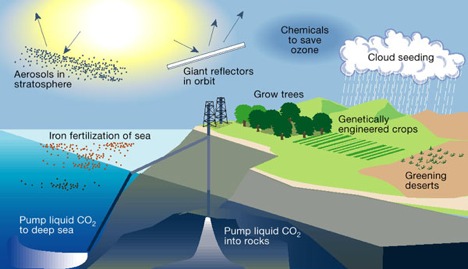
The objective of CDR is, clearly, to reduce the concentration of Carbon Dioxide and other GHG from the atmosphere. It is a great solution, given that it works upon the root of climate change, and would therefore improve all its consequences. However, it is a much slower and expensive process. Additionally, none of the considered techniques have been proved to work without any severe side effects. One of the techniques involves capturing and compressing CO2, and storing it in porous rocks or into deep sea. Another technique is adding iron into the sea. This way we stimulate the growth of algae, that consume CO2. When these die, they would bury this CO2 in the bottom of the ocean with them.

The following picture illustrates some of the techniques we are to discuss in following posts:
Source
In the next post we are going to explicitly discuss powerful SRM techniques, along with their side effects.

Keep in touch!


Sunday, 9 November 2014

Introduction to solutions: TED video


The following Ted video is really interesting, because, as usual, it provides information in a very casual and understandable way. Also, it is a perfect introduction for our next entries.


Things that really caught my attention:
  • I think the paper from 1953 about "How industry may change climate" is really interesting, and in case you want to look at it, it can be found here.
  • Nowadays, we are always reading about current projections, and (at least I) didn't know how close/far away old projections turned out to be in comparison with reality. In minute 1:30 he says skeptics did not believe the future to be as terrible as the worst case scenario considered, and the future was actually worse than the worst case scenario. I consider this to be really interesting, and you can read more about it here.
  • I consider the following image very enlightening, given that it summarizes the three types of possible solution to this climate change problem. Also, we can compare the importance given to geoengineering with the importance given to the other two solutions by looking at the titles of the IPCC workgroups. (The workgroup II of the IPCC is called "Impacts, Adaptation and Vulnerability", and the third "Mitigation of Climate Change".)

We will discuss his particular "solution" to climate change via geoengineering in depth in another post. 

I hope you enjoyed it! 

:) goodbye!!

PS: a really interesting interview with David Keith (the lecturer in the video) about his views on why geoengineering is a great solution to our current problem can be found here.

A peek into the future

After realizing climate change is real and that we are its dominant cause, the next question is to find out how dangerous it is.

IPPC projections

The future of climate change not only depends on the present and the dynamics of the environment, but also on future emissions made by us. This is why four possible emission scenarios are considered: Representative Concentration Pathway (RCP) 2.6, RCP 4.5, RCP 6.0 and RCP 8.5, being RCP 8.5 the most dangerous option.

The following image from AR5 describes (a) the future anthropogenic radiative forcing considered for each possible pathway, (b) their components in terms of their radiative forcing, (c) their components as the percentage of the total radiative forcing:


The result is the following:


Since 1996, the EU is anouncing we should not let global warming overpass 2°C above pre-industrial revolution (Randalls, 2010). However, we are already at 0.8°C above pre-industrial temperature, and as you see in the projections above, we have to significantly reduce our carbon emissions immediately if we want to stay beneath that boundary. In fact the IPCC states we have to completely phase out fossil fuel emissions by 2100 if we do not want to suffer an extreme and irreversible climate catastrophe.


Impacts of global temperature increase:

We will give a short summary of some of the most important points. Impacts are deeply discussed in the IPCC reports, and for more details you should read the AR4 or AR5. All information below, except otherwise stated, is taken from the AR4.
  • The proportion of land in extreme drought conditions is projected to rise from a current 1% to 30% in 2090.
  • "The number of extreme drought events per 100 years and mean drought duration are likely to increase by factors of two and six, respectively, by the 2090s (Burke et al., 2006). "
  • The water quality will significantly deteriorate leading to an important rise in health issues. 
  • By 2100, the combination of increased humidity and increased temperature will threaten food growth, and therefore food prices are expected to significantly rise. This will have as a consequence a rise in diarrhoeal diseases and malnutrition in low income populations. 
  • Rise in malaria, dengue and other infectious diseases. Rise in respiratory and cardiovascular diseases.
  • If we reach an increase of 1.5-2.5 °C, 20-30% of species  are expected to be extinct. If we excede 3.5 °C, the number rises to 40-70% of species to be extinct.
  • Ocean acidification: It is estimated that from one half to one third of the CO2 emitted after the industrial revolution was absorbed by the ocean. This means it acts as the biggest CO2 sink. CO2 absorbed by the ocean lowers the pH of the water, and it has decreased from 8.19 to 8.05 from industrial revolution (30% increase in terms of the acidity, because remember the pH scale is logarithmic). Ocean pH is expected to decrease in 0.5 units by 2100 in the ocean surface. This affects the ability of water animal's blood to carry oxygen, therefore affecting their growth and reproduction. In addition, 30% of warm water coral reefs have dissapeared since 1980, and models project the total extinction of reefs. This has major consequences because of the enourmous amount of animals that feed on them. 
          The following image from IPCC AR4 sumarizes the projections for species and ecosystems:

  • By 2081-2100, there is to be an expected 0.45-0.82 m rise in sea level. Therefore, the coastlines will significantly change and low lying areas are threatened by the general sea level rise or by floods. A significant economic loss is projected.  


The following image briefly synthesises the IPCC projections for each of the paths clarified earlier:
Source: IPCC

Probably the best and more illustrative column in the table above is the one that indicates the percentage of emissions we have to reduce by 2050 to be at the indicated category, and the consequences. It clearly illustrated that to avoid overpassing a 2 degree change we need to lower the CO2 emissions by 72% to 41% by 2050. However, China stated they are going to peak emissions in 2030... So that is a very high aim to achieve. 

So...


I consider all of this overwhelming, and sufficient evidence to affirm this is an urgent matter, and something must be done if we do not want to continue through the RCP8.5 path. Additionally, these changes we need to make take a long time to be established, and therefore we need to act NOW. 

In following entries we will address possibilities of things to be done, to answer the question:

Is there any hope? 


I leave you with the sad cartoon of the day:


See you later!!!  :D

Tuesday, 4 November 2014

Guilty?

Last entry I told you about a discussion with my non-environmental friends. The second argument they made is the following:
The world has seen a lot of climate changes in the last millennium. Why affirm this is our fault?

In its fifth assessment (AR5), the IPCC has agreed that scientists are 95% sure that humans are the "dominant cause" for global warming since 1950.

Let's first follow a simple train of thought:
  • Fact #1: In our first entry we discussed the atmospheric CO2 was as high as it has ever been for the last 650.000 years. The atmospheric concentration of other gases like methane or nitrous oxide have also suffered an exponential increase as a result of human activity since the industrial revolution, as we can see in the image below by IPCC
Atmospheric concentration of carbon dioxide, methane and nitrous oxide in parts per million/billion over the last 10.000 years, taken from IPCC AR4.


It is worth mentioning that the primary reasons for the increase in CO2 are fossil fuels and land use, while for methane and nitrous oxide it is agriculture. So there is no doubt we are responsible for these increases in emissions.

  • Fact #2: CO2, methane and nitrous oxide are Greenhouse Gases (GHG). This means they contribute with the greenhouse effect. If you do not know how the greenhouse effect works, I suggest the following short, very complete and very nice video taken from NASA:

  • Fact #3:CO2 is not only a regular GHG. The IPCC has agreed that CO2 is the most threatening GHG due to it's radiative forcing. The IPCC defines in its AR4 the radiative forcing as:

"Radiative forcing is a measure of the influence a factor has in altering the balance of incoming and outgoing energy in the Earth-atmosphere system and is an index of the importance of the factor as a potential climate change mechanism."


The consecuence of the three facts we just discussed is only one: we are, in fact, important contributors to this climate change. 


The IPCC confirmed this. 

Image (a) shows the radiative forcing of different agents. We can see the radiative forcing of CO2 is the highest of them all. But what is most interesting about this image is that it separates anthropogenic factors from natural ones.  

     
We can easily compare the natural radiative forcing (only from solar irradiance) to the total net anthropogenic one to reach one conclusion: anthropogenic factors are the main cause of climate change. The evidence is convincing.

However, at the same image we can see there is a column regarding the Level Of Scientific Understanding (LOSU) indicating the confidence of the information shown. This is why, on it's fourth assessment the IPCC declared they were 90% confident humans were the dominant cause of climate change. However, on their fifth assessment, this percentage increased to 95%.

I leave you with two cartoons today!!


On the next entry we will discuss to what extent is climate change important, and why do we need to fight it right now!!

See you later, alligator! :D

Sunday, 2 November 2014

Believing in climate change


Hello again!!

The other day I was speaking to my non-environmental friends, and when we discussed the importance of climate change they were really unconvinced about it. Some didn't consider climate change was a very big issue; others thought it is a natural process that has nothing to do with human activity. So, before analyzing if we can do anything to revert or stop climate change, I'm going to dedicate this entry (and probably the next one), to understand the importance of this subject.

The Intergovernmental Panel on Climate Change (IPCC) has affirmed in its AR5 that:

"Warming of the climate system is unequivocal, and since the 1950s, many of the observed changes are unprecedented over decades to millennia. The atmosphere and ocean have warmed, the amounts of snow and ice have diminished, and sea level has risen."


Note: Since I will be using a lot of the IPCC statements and projections, I thought this might be a good time to clarify who they are. As their name suggests, they are an Intergovernmental panel of scientists working under the UN. Their reports intend to cover 
"the scientific, technical and socio-economic information relevant to understanding the scientific basis of risk of human-induced climate change, its potential impacts and options for adaptation and mitigation." 
(Source: Principles Governing IPCC Work)
I should also say that the IPCC doesn't carry out their own research but, rather, assesses all the existing literature and extracts conclusions from that. They are considered the authority on the subject, and that's why I'll be quoting them so much.
The IPCC is the organisation that shared the Nobel Peace Prize with Al Gore in 2007. 


Let's continue. There are ten parameters of the physical world that can prove the veracity of a global warming. These are synthesised in the following picture.

Source: NOAA

We will give the details for just a few of these indicators, but it should be noted that all of these parameters are changing in the direction that proves global warming is occuring.
  • First, air temperature near surface. The average temperature has increased 0.6°C in the last 30 years. If we consider the last 100 years, the global change would be of 0.8°C. This can be seen in the graph below: 
    Image showing annual mean temperatures and 5 year mean temperatures since 1880. Taken from Hansen et al. (2006)
  • Second, we can observe changes in the snow and ice covered area. The Arctic sea ice extent has decreased at an average annual rate of 2.8% per decade since 1978. Additionally, the graph below shows the decrease in snow covered area since 1920 in the northern hemisphere. 
Source: IPCC AR4
  • Third, the global average sea level has grown at an average annual rate of 1.8mm per year from 1961 to 2003. However, if we only consider the average from 1993 to 2003, the average sea level rise would be of 3.1mm per year. 
Source: IPCC AR4
Something that really surprised me is the main reason of sea level rise, and therefore I consider worth mentioning it. According to IPCC, the ocean's "thermal expansion" is responsible for 57% of the global sea level rise. The ocean has always acted as a buffer with global temperature, absorbing or releasing heat according to the global temperature. So "thermal expansion" is the expansion produced by the absorption of heat by the ocean. The following graph shows the evolution of this magnitude in the last 50 years in the upper 2000m of the ocean.

Source: NOAA


Apart from considering these formal indicators, we can observe other global change characteristics of the Earth like the following ones taken from IGBP Global Change. In this webpage you can find evolution graphs for almost everything in the world, and I recommend you check it out!
I chose the three I liked the most. Or rather disliked, for what they represent.

Number 1: tropical rainforest and woodland.


Number 2: ozone. Really amazing numbers. No wonder exposures to the sun are getting dangerous. Besides this first consequence, you can get a list of impacts of ozone depletion here.


Number 3: species extinctions. My heart broke when seeing this. Maybe you will share my sorrow for ruining the planet not only for ourselves, but for other species that were living here long before us.


It should be noted that these three are indicators of global change, and not necessarily of global warming. Still, the evidence that they are anthropogenic is staggering. Thus, correlation is established, if not causality.


Number 4: I leave you with the final and most important evidence:
Dave Granlund :)


SUMMARY: climate change is REAL, the evidence is really unequivocal.

In our following entry we will discuss the main causes of climate change. See you soon!

:D